Adapting Buildings to Climate Change
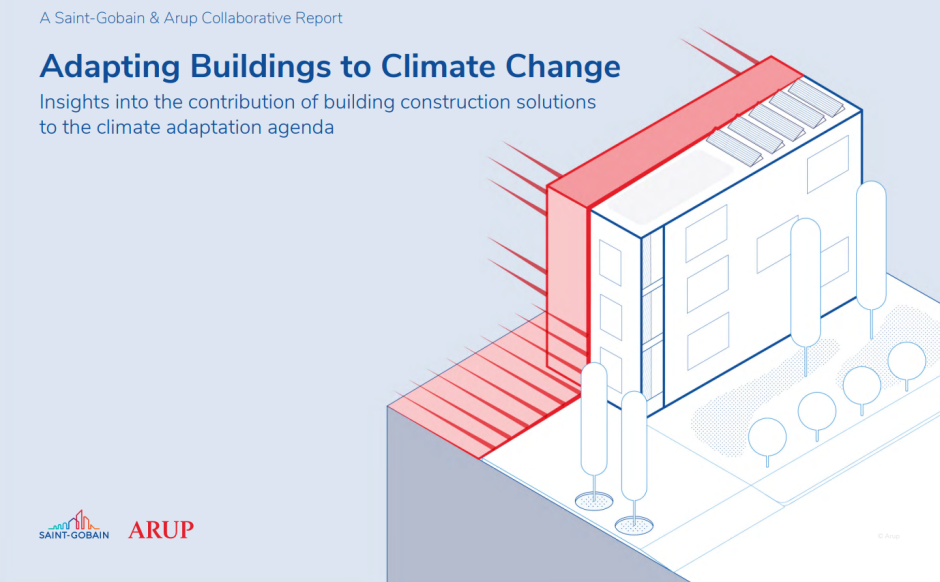
Buildings must be designed differently to withstand a changing climate, according to a new report from Saint-Gobain and global built environment consultancy Arup.
Adapting Buildings to Climate Change: Insights into the contribution of building construction solutions to the climate adaptation agenda explores the changes designers, architects, engineers, developers and investors need to make to ensure buildings better withstand the growing impacts of extreme weather events and conditions.
It describes the need for adapting buildings, illustrates ways to achieve this at the design stage, and shows how available construction products and systems can support these goals in diverse settings.
9 Key Messages for Action:
1. The adaptation imperative: Climate change is the defining challenge of the current and future built environment: existing buildings must be retrofitted and new buildings fundamentally rethought.
2. A dual relationship with climate: Buildings must cope with acute (extreme winds, storms, wildfires, floods) and chronic pressures (rising average temperatures), while also reducing their Urban Heat Island input into cities.
3. A challenge of scale: New better design must be accompanied by largescale retrofitting as in some regions up to ~90% of building in 2050 already exists today scale retrofitting is critical.
4. Complementary design strategies: Climate adaptation relies on a mixed approach combining robustness, adaptiveness and flexibility, allowing light, low‑carbon construction to coexist with resilience.
5. Pathways to adaptive design: Multiple techniques are in use—risk analytics, reframed architectural relationships with the environment, climate data, adaptive technologies and digital tools—to integrate present and future risk in workflows.
6. Evolving building codes and risk transfer: Codes are starting to integrate climate change but at a measured pace; in parallel, mechanisms to transfer residual risk that cannot be excluded are gaining importance, with uneven maturity across regions.
7. A growing market for adaptation: The construction solutions sector is moving towards hazard‑specific products, performance‑enhanced mainstream solutions and repositioned offers for climate risks, acknowledging the investment opportunity.
8. Performance and integrated systems: The market is shifting from isolated products to integrated, performance‑based systems—assemblies of components designed to work together under multi‑hazard climate conditions.
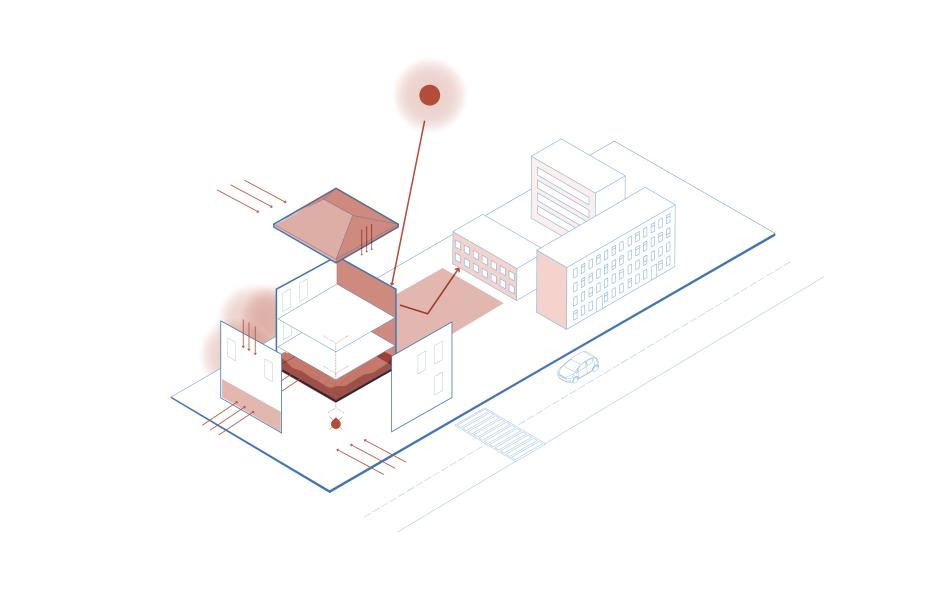
9. Buildings’ first lines of defence: Building envelopes and site are the primary defences against climate stresses, which construction systems can target adaptive solutions focus on building envelopes and their immediate surroundings as the primary defences climate impact.
- Global warming has already passed the +1.5 °C threshold above preindustrial levels in 2024; land regions such as Europe and North America have warmed faster than the global average, while India’s mean temperatures have risen by about 0.7 °C since the early 20th century.
- Even with ambitious mitigation, Earth system inertia means additional warming is locked in over the next decades: by around 2050 both moderate (SSP24.5) and high (SSP58.5) emission scenarios converge around and above 2 °C increase in temperatures against preindustrial level but diverge significantly by 2100 (about 2.7 °C for moderate scenarios versus 4.4 °C for high scenarios).
- This warming alters climatic impact drivers relevant to buildings: more frequent and intense heatwaves and extreme temperatures, heavier rainfall and pluvial/riverine floods, more severe storms and wind events, longer droughts, and increased wildfire weather in many regions.
- Additionally, Urban Heat Island (UHI) is contributed to by buildings’ choice of materials, colours, geometry, layout and density, raising temperatures and compounding heat stress and cooling demand.
- Between 2000 and 2019 more than 7,000 major disasters were recorded globally, causing widespread economic and material losses, with buildings and infrastructure substantially affected. Events in 2024-2025 such as Valencia catastrophic flooding, Hurricane Helene in Florida and heatwave days in New Delhi, exemplify how intensified hazards are impacting buildings today.
- IPCC latest projections show that increased temperatures, erratic rainfall patterns and sea level rise may further exacerbate hazard profiles and increase risks, potentially leading to more disasters.
- Prevailing hazards across the world will include extreme heat, increasing average temperatures; extreme winds, storms; extreme rainfall; wildfires.
- For buildings, these changing drivers may translate into even more acute (structural damage, façade and roof failure, water ingress, fire exposure, loss of power and services) and chronic pressures (overheating, increased HVAC loads, accelerated material degradation, moisture and mould issues).
- In advanced economies, around 80% of the buildings that will exist in 2050 are already standing, while shares are lower but still critical in many emerging markets: this makes retrofitting and adaptation of existing stock a central task alongside resilient design for new construction.
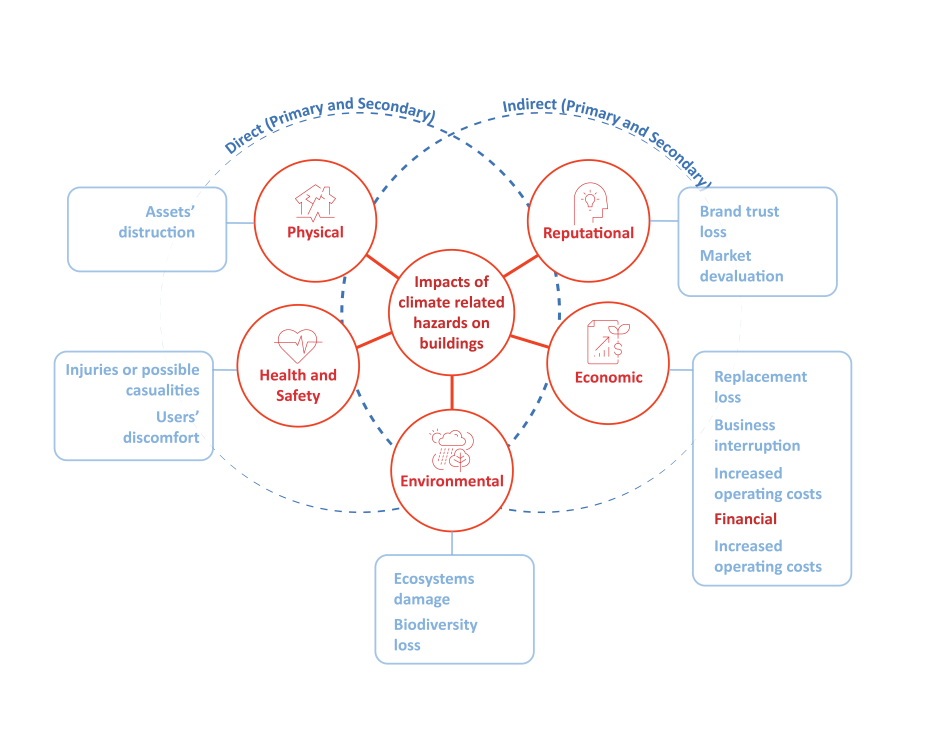
- Adaptation is becoming a core design driver alongside comfort, aesthetics and carbon reduction.
- Three complementary approaches to adaptation and resilience are used together:
Adaptiveness: solutions that allow controlled interaction with hazards without catastrophic failure, such as sacrificial ground-floor levels that can flood without compromising structural integrity, thereby reducing downtime and repair costs.
Flexibility: modular, upgradable systems façades and structural elements, kinetic shading and monitoring that allow components to be replaced or enhanced as climate conditions evolve, rather than relying solely on initial over-dimensioning.
- Multiple design methods are currently emerging in the practice, although adaptation is not yet streamlined in the design workflow:
Climate Risk Assessments (CRA) are increasingly standard, using IPCC/CMIP6 scenarios and ISO 14090/14091 standards to and prioritise adaptation solutions based on risk analytics. They are increasingly used to inform decisions including protective and passive design measures, although the practice is not yet streamlined.
Architectural considerations. Primary architectural choices—massing, orientation, façade proportion and the building’s overall relationship with its environment—are more deliberately used to anticipate and respond to projected climate conditions and drive architectural concept, rather than simple add-ons.
Engineering considerations. Engineers are beginning to consider forward-looking design loads for structures, water management and HVAC systems, supplementing code-based historical loads with climate scenario data. This includes, for instance, resizing drainage for higher intensity rainfall, checking structural robustness under future regimes, and reevaluating HVAC sizing for hotter peaks. These climate model-informed considerations are often beyond-code best-practice and not yet standard.
Materials, products and systems. Designers can draw on a wide sandbox of construction systems that can contribute to address risks, such as assemblies that provide better thermal performance, moisture management or impact resistance. There is a shift towards integrated, pretested systems where insulation, membranes, fixings and finishes are coordinated to perform under multi-hazard scenarios.
Solutions to reduce residual risks. Recognising climate uncertainty projects incorporate solutions—such as flood gates, sacrificial spaces—to address residual risks that cannot be fully designed out, especially in existing buildings.
Digital tools. Digitally and AI-driven design is increasingly supporting multi-criteria design, including resilience and adaptation parameters. Parametric design and digital twins support scenario-based optimisation of forms, envelopes and systems under different climate futures. AI-driven predictive maintenance for façades and MEP, and adaptive control systems and BMS, are emerging to manage resilience in operation, including responding to heatwaves, storms and other stress events.
- Value-chain collaboration: Alignment across investors, regulators, designers, contractors, owners, tenants and insurers is required for adaptation.
- Risk transfer. Residual risks that cannot be designed out or addressed in the life-cycle of the building (for either technical or economic reasons) are increasingly being transferred, for instance through insurance, to varying levels across regions.
- The building envelope and site are recognised as the first lines of defence against climate hazards, combining robustness, adaptability and flexibility.
- The construction solutions sector is evolving through three main responses: hazard-specific products, performance upgrades of mainstream solutions, and repositioning of existing products as hazard-focused measures.
- Performance criteria for climate resilient systems include: durability and longevity (UV/colour stability, freeze–thaw cycles and thermal shock resistance; corrosion protection); structural resilience (tensile/compressive strength; impact and tear resistance); thermal and solar performance (thermal resistance, thermal inertia; SHGC/g-value; albedo/SRI, Visible Light Transmittance VLT); water resistance and vapour control (Hydrostatic pressure/penetration resistance; water vapour diffusion resistance; permeability and infiltration rate, runoff reduction potential); fire performance (reaction to fire and fire resistance); environmental sustainability (embodied carbon, recycled/bio based content, local sourcing, modularity, easiness of disassembly); cost and availability (total cost of ownership, supply chain resilience, ease of deployment).
- Market overview and regional dynamics: Climate-resilient materials are projected to grow at around 6–8% Compound Annual Growth Rate, supported by adaptation investments estimated up to roughly 0.5–1.3 trillion USD per year by 2030, although the adaptation financing gap remains large and current flows may only close around 5% of estimated needs.
Europe shows policy-driven demand via EPBD and EU Taxonomy, with adoption of advanced façades/insulation, green roofs, permeable pavements.
India is seeing emerging adoption through pilot projects and smart-city programmes, with growing use of insulated glass units, shading systems and nature-based solutions for monsoon-driven risks.
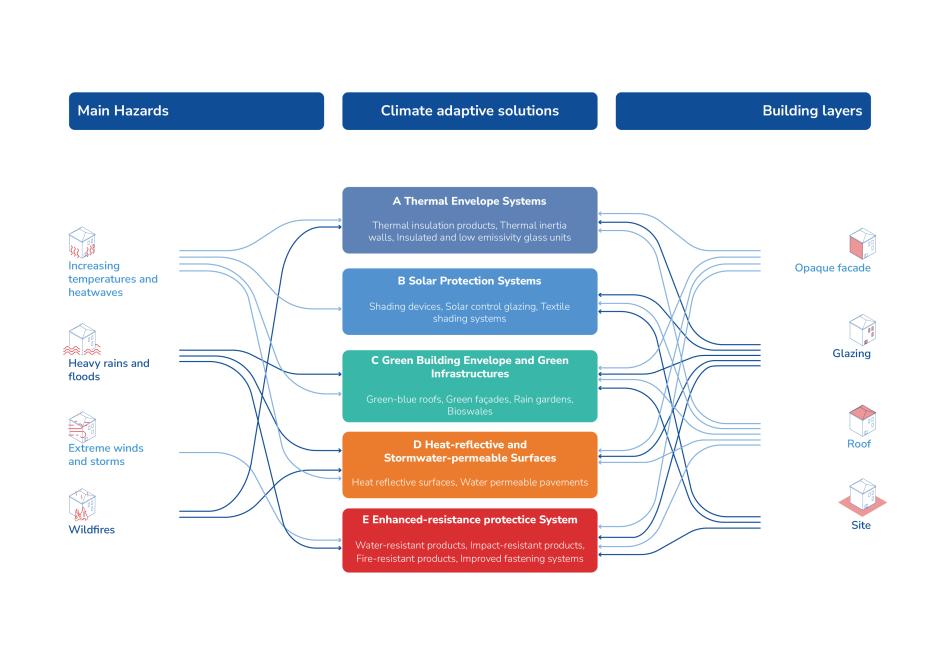
The United States exhibits code and insurance-driven uptake through programmes like FORTIFIED and FEMA/ICC guidance, particularly for multi-hazard protective envelopes, alongside continued demand for energy-efficient envelopes. - Climate adaptative solutions for systems, materials, and products include five main families:
A. Thermal envelope systems, such as continuous high-performance insulation, thermal inertia wall systems and low emissivity insulated glazing units (IGUs), as well as hybridised vernacular materials such as engineered earthen walls and bamboo systems. Benefits include: stabilise indoor temperatures, reduce energy demand and improve comfort under higher outdoor temperatures and co-benefits include enhanced fire reaction/resistance and reduced water permeability.
B. Solar protection systems comprising external shading (overhangs, fins, adjustable louvers), solar control glazing and tensile/textile structures applied to façades and outdoor areas. Benefits include: reduce solar heat gains and overheating while maintaining daylight and views, support comfort and energy efficiency during heatwaves and in warmer climates and help limit rain penetration on façades.
C. Green building envelopes and green infrastructures including green-blue roofs, green façades, bioswales and rain gardens integrated in and around buildings. Benefits include: mitigate UHI effects, attenuate stormwater volume and peak flow, enhance biodiversity and air quality.
D. Heat reflective and stormwater-permeable surfaces consisting of high albedo coatings and membranes for building envelope surfaces and pavements, permeable interlocking pavers and porous concrete. Benefits include: increase Solar Reflectance Index (SRI) to cool microclimates, support infiltration and aquifer recharge, improve safety during heavy rainfall by reducing runoff.
E: Enhanced-Resistance protective systems including water resistant membranes and rainscreens, impact resistant cladding and glazing, fire resistant products, and reinforced fixings and fasteners. Benefits include: resist wind uplift and debris impact, limit water ingress and provide fire protection, thereby extending asset lifespan and potentially reducing insurance costs.
The following is a non-exhaustive selection of references used for data reported here. For the full list of references used, please refer to the main Adapting Buildings to Climate Change Report:
- IPCC – Sixth Assessment Report (AR6), 2021 — Global warming thresholds, SSP2‑4.5 vs SSP5‑8.5 divergence (2.7 °C vs 4.4 °C by 2100), mid‑century convergence near ~2 °C, and attribution of intensified hazards.
- IPCC – Climate Change 2023: Synthesis Report, 2023 — Every additional 0.5 °C of warming causes discernible increases in hazards.
- CRED / UNDRR – The Human Cost of Disasters: An Overview of the Last 20 Years (2000–2019), 2020 — Over 7,000 major disaster events
- IEA – Air Conditioning Use Emerges as One of the Key Drivers of Global Electricity‑Demand Growth, 2018 — Global AC demand projected to triple by 2050
- European Commission – A Renovation Wave for Europe, 2020 — An estimated 85–95% of EU buildings existing today will still be in use by 2050.
- World Bank / Inter‑American Development Bank – A Global Assessment of Building Codes, 2025 — Codes often rely on historical climate data; typical 3–5‑year update cycles seem to be lagging behind climate change.
- FEMA – Building Codes Strategy (2022, revised 2025) — Every $1 invested in code‑compliant construction saves up to $11 in future disaster losses (FEMA / NIBS Mitigation Saves study).
- JLL – From Climate Risk to Climate Resilience, 2024 / How Climate Risks Are Impacting Real Estate Insurance Costs, 2025 — ~€580 billion (37%) of European CRE in the top 10 most climate‑vulnerable cities; US commercial premiums up 88% over five years.
- Global Center on Adaptation – Adapt Now: A Global Call for Leadership on Climate Resilience, 2019 — Climate adaptation investments could generate $7.1 trillion in net benefits by 2030.
- BCG – Investment Opportunities in Climate A&R Market, 2025 / Sustaining the Private Capital Opportunity in Climate, 2025 — Climate adaptation projected up to $1.3 trillion annual opportunity by 2030; climate‑resilient building materials growing at 6–8% CAGR; façade and insulation solutions leading growth; current adaptation finance ~$28 billion (2022); projected annual need $0.5–1.3 trillion.
- UNEP – Adaptation Gap Report 2024 — Developing‑country adaptation finance need estimated at $187–359 billion/year.
- Copernicus Climate Change Service (C3S) (2025) indicates that 2024 was the first calendar year with an average global temperature exceeding 1.5°C above pre-industrial level. Global Climate Highlights 2024 Report