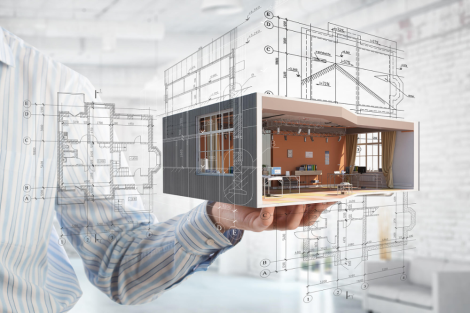
What if Generative AI could help us build more sustainably?
There seems to be no stopping the meteoric rise of artificial intelligence. And with good reason: its spectacular progress is opening up an ever-increasing number of areas of application. Construction is no exception. From optimized project design to more efficient and sustainable building management, AI, and generative AI in particular, is set to shake up practices in the sector.
It is a revolution in images, words, and videos. With a simple written or spoken query – and not lines of code! – Generative AI is revolutionizing the human-machine interface. The goal is to improve productivity and efficiency in all business sectors. Light and sustainable construction is no exception. GenAI is proving particularly useful in optimizing building design and improving energy efficiency. From the design of materials to the life cycle of buildings, AI is now found everywhere.
Smart design: AI as the architect of sustainability
For example: how do you choose the most appropriate materials for a project while meeting sustainability goals? With its capacity for in-depth analysis, GenAI can assess the environmental impact of materials, their cost, their availability, adjust the shape and orientation of a building to maximize natural sunlight, test the strength of structures, or adapt to the specific preferences and needs of users. The economic benefits of such an approach are enormous.

Saint-Gobain is also exploring the potential of this new technology to model and design the materials and solutions of the future, drawn from the circular economy and recyclable by design. “As circularity becomes firmly established, we’ll be re-using materials from a variety of sources, which will become the inputs in our recipes,” says Renaud Jahan, the Group’s Chief Information Officer for Innovation. AI will enable solution formulations to be adjusted at will according to the incoming raw materials available. “Take the gypsum currently coming out of our mines, for example. It’s a bit like the flour you buy in the supermarket. It is calibrated and thus always consistent. Now imagine collecting leftover flour from here and there and mixing it all together. You won’t necessarily end up with the same type of flour, and your favorite recipes may not turn out as well. In this example, AI could revise the formula of your flour mix to give you exactly the type of flour you’re used to buying. The same applies to gypsum made from recycled materials.”
Innovation: the discreet charm of continuous improvement
Optimized production: when AI controls the plant
Beyond the “cooking” of materials, AI could also cook up a factory of the future built around machine learning. At Saint-Gobain, for example, predictive modeling is used by the High Performance Solutions businesses to optimize furnace operation in fiberglass production.
“Just imagine furnaces that could automatically adjust their parameters for maximum efficiency, especially energy consumption and waste generation. This is already a reality in some of the Group’s plants,” says Renaud Jahan. This capacity for anticipation not only helps to avoid quality defects, but also to continuously optimize the production process. The result: lower energy consumption and less waste.
For plasterboard, AI could calculate optimal board placement to minimize cutting and waste. It could even coordinate the pre-cutting of boards at the plant according to a precise digital model. The result? A ready-to-install “assembly kit” delivered to the building site. This would considerably speed up installation while significantly reducing energy consumption and waste during construction. The icing on the cake is that offcuts could be immediately recycled in the factory, closing the loop on an optimized, sustainable production process.
Smart buildings: AI to bring structures to life
Buildings themselves could also become smart through use of AI.
Imagine a building that knows that there are fewer people around on Fridays than on Tuesdays or Thursdays. Using predictive models, connected systems could adapt the ventilation and air-conditioning systems at any given moment, thus reducing energy consumption. This optimization would be based on smart data, e.g. the number of active Wi-Fi connections.

Platforms like Honeywell Forge have already taken on the challenge, using machine learning to optimize heating, ventilation, and air-conditioning systems in real time. The result is more energy-efficient buildings and greater comfort for their occupants.
Blockchain: a potential ally for sustainable construction?
Even more impressive is ARIA (the Artificial Responsive Intelligent Assistant), developed by Canadian company BrainBox AI. It analyzes, gives advice, and automates various tasks related to the life of the building. Prediction of needs and potential problems, recommendations to optimize energy efficiency and the comfort of occupants, interaction with users by text or voice command on computers or mobile devices. Reality is catching up with fiction.
AI could even push back the boundaries for buildings at end of life, by simulating their optimal demolition and predicting which materials could be recovered and incorporated into new projects! This would transform demolition into a smart “disassembly” process, maximizing the potential for re-use and recycling.
Artificial intelligence is emerging as a powerful tool for designing the more efficient, more sustainable and more comfortable buildings of the future. But let’s not forget that it is human expertise that lies behind every algorithm and every predictive model. AI is there to assist, not to replace. And its effectiveness will always depend on the quality of the data it is fed and the relevance of the questions it is asked. The future of construction will thus be a collaboration between human intelligence and artificial intelligence, in the interest of a more sustainable world.
The cover visual is AI generated.