Promoting gender diversity in the construction sector
Construction is getting a makeover. In design offices and on construction sites alike, women are shaking up tradition in a rapidly changing sector. The energy transition, digitization and new ways of working are creating a favorable climate for this move towards feminization. How can companies get on board and break down the last barriers?
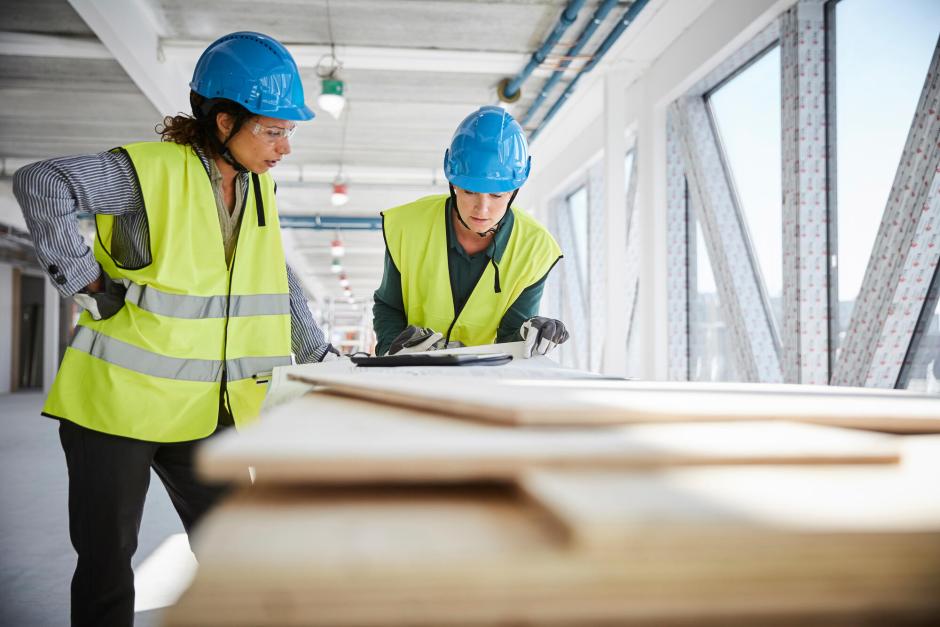
These women are crane operators, engineers, HR directors and site supervisors. In just a few years, the once male-dominated construction sector has overturned its own codes, feminizing the teams on building sites, in workshops and right up to management positions. This underlying trend clearly demonstrates that, more than ever, women have a rightful place in the construction professions. And this is good news, as the sector offers many opportunities with its diverse range of trades and positions. It only remains to find out what they are and, above all, “unravel” some of the received wisdom.
Where are the women in construction?
There is still a major imbalance: according to a FEMCON study, women account for just 9% of the sector’s workforce in Europe. This figure rises to 11% in the United States, according to the Bureau of Labor Statistics, and 12% in Asia and India.
However, the tide is gradually turning. Women are increasingly to be found in the different branches of the sector, though their distribution is uneven. They are much more likely to work in support and supervisory roles (research and development, sales, IT, finance, logistics) than in operational jobs in the field.
At Saint-Gobain, women now account for almost a quarter of the global workforce – around 40,000 of the 160,000 employees. Their numbers are growing at all levels in the company, including management positions. The figures are encouraging: in 2023, almost 30% of new hires were women. But the Group wants to go further and has set itself an ambitious target: 40% of new managers recruited by the end of 2025 will be women.
While this concentration in “office jobs” reflects a positive trend, it also underlines how far we still have to go to achieve true gender diversity throughout the sector’s professions.
Awaken vocations and promote inclusion
To achieve these goals and bring about a lasting change in attitudes, numerous initiatives are being launched across Europe.
The European Women Can Build project, led by the Spanish construction industry trade association, illustrates the action being taken by the sector to promote gender diversity and raise awareness of its different branches. To date, six European countries (1) have signed up, with the same commitment to women’s inclusion and the gender diversity of teams.
In France, professionals have also taken up the subject and are launching many initiatives to demystify the sector. In France, Saint-Gobain Group has been working for several years with Capital Filles, an association created in 2012. Its aim is to open up the field of possibilities for girls from priority city neighborhoods and rural areas. Female Saint-Gobain employees accompany these girls from all over France through a mentoring program lasting a full school year. For the 2024-2025 edition, 78 of them have taken up the role of ambassador. These dedicated professional women share their experience of the world of work, introduce the diversity of jobs available within the Group, and guide the career choices of the pupils they sponsor. All this helps these high school girls build their self-confidence and look to their professional future. And to consider a career in the construction sector.
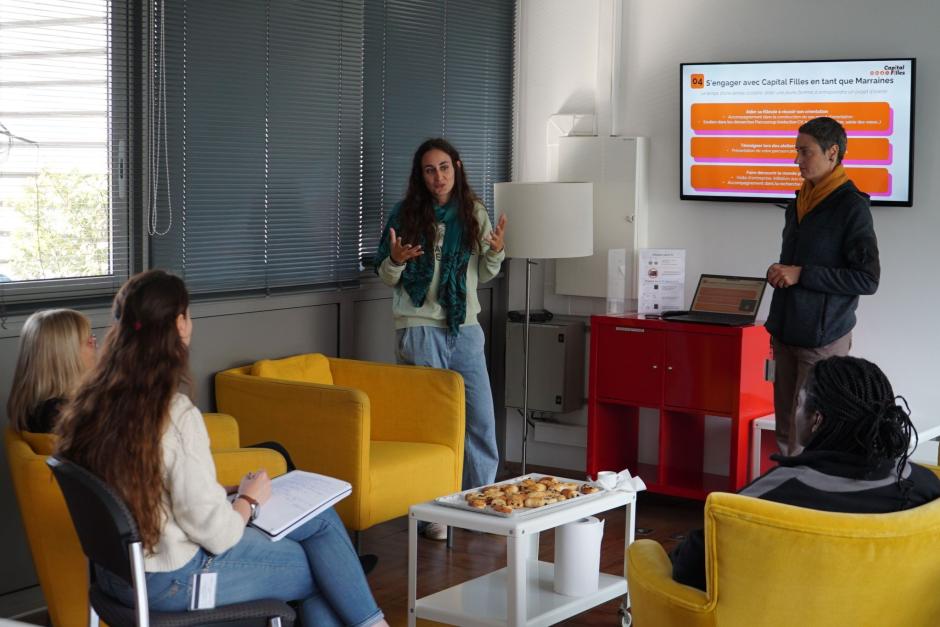
“What’s striking is the lack of knowledge about the sector,” says Magdalena Panek, Human Resources manager at PUM. “These young women don’t begin to imagine the wealth of jobs on offer in a group like ours. They also wrongly believe that this sector offers no opportunities for women and that they have no place in a large group.”
Saint-Gobain’s commitment doesn’t stop there. In Kenya, for example, the Saint-Gobain Foundation has been supporting the Buildher initiative since 2019. This program guides women towards careers in construction and industry. Training for a diploma, social support and job-seeking assistance are on offer, to help them move towards greater financial prosperity. 159 women have already taken part in this program. In 2023, they were able to put their skills to good use, with the restoration of an ablution block in the disadvantaged Korogocho district of Nairobi. In addition to improving access to essential services for many households, this project has enabled the students to forge links with the local community.
Countering preconceptions
“The young women we meet ask us a lot about working conditions and work-life balance,” says Louisa Maréchal Fabre, CSR director for Benelux and Act sustainably (2) coordinator for the Southern Europe, Middle East and Africa Region at Saint-Gobain. “In the end, they are reassured to know that they don’t have to choose between professional development and family responsibilities. That higher education is not necessarily essential for a successful career. And that it’s possible to be the only woman in a team and still find your place!” These recurring questions are indicative of the lack of information available to women about realities in the sector.
To correct this, several associations have set themselves the task of promoting the construction trades to women. This is the case for Femmes ingénieures, which aims to promote the engineering professions to young women at school and in higher education. For its part, the BatiFemmes network for female finishing-work professionals informs girls, and women undergoing retraining, about opportunities in the sector, in the hope of sparking vocations.
In schools and on building sites, prejudices are also being peeled away. It is essential to debunk the stereotypes that are still an obstacle to the recruitment of women. The harsh nature of work in the construction sector is certainly the most common. However, the sector has changed enormously, with less heavy lifting, automation of tasks, digitization of processes, and so on. All these advances have made it easier for women to enter professions once considered “physical” or “arduous”.
In a sector like joinery, gender diversity is becoming a reality in apprentice training centers (CFAs). And it’s no longer unusual to come across a female house painter on a building site. However, some trades like roofer, bricklayer or plumber still struggle to attract young women.
The biases which impact the recruitment of women
Women in new roles
The construction sector is resolutely opening up to gender diversity, as demonstrated by Saint-Gobain North America’s “empowHERed” initiative. This series of portraits highlights the inspiring careers of women in the industry. April Carum, now an HR specialist at CertainTeed in Palatka, Florida, is a perfect example of this career progression. Starting out as a production operator for 9 years, and then working on reception and unloading of materials, she admits: “I don’t feel I would be as good in my role as a human resources specialist if I hadn’t had all the training and the background in production. I know what our teams are about to go through.” She adds, “When you start out as a female in a mostly male-dominated industry, you hear things like ‘Oh, she’s not going to make it’. But I’m here to prove them wrong, and I did that.” Today, she is proud to note that more and more women are working in the sector, and that they are no longer afraid to climb the ladder. According to her, they’re more determined than ever, and don’t let anything stand in their way.
The energy transition and sustainable construction are also attracting people from different backgrounds – civil engineers, materials scientists, construction engineers – like Hélène Grussaute.
After graduating from École Centrale Paris twenty years ago, in a class with only 10% women, she went on to become director of the Saint-Gobain Chantereine plant. Her experience reflects the changing attitudes in the sector: “When I was the only woman in a meeting surrounded by men, I felt they were thinking ‘it’s just the woman speaking’,” she recalls. “The issues I brought up, probably because they weren’t very common at the time, weren’t considered important.”
Her international career enabled her to identify significant cultural differences: “It was much easier to be a woman in China than in France,” she says. When she returned to France in 2021, she did see a positive change in attitudes: “Since then, I have not heard a single sexist joke or remark. There are a lot more women at meetings, and I see a greater openness to diversity of all kinds.”
Diversity and inclusion - or how to attract talent
While the road to parity in the construction sector is still long, more initiatives are emerging and mindsets are changing. Saint-Gobain is keeping up its commitment with ambitious recruitment and training targets. The development of new ways of working, increased digitization and the challenges of sustainable construction are creating favorable conditions for greater gender diversity.
Beyond the numbers, an entire culture is changing. The stories of women who have succeeded in the sector, the emergence of self-help networks and the mentoring programs all serve to inspire the next generation. More than ever, there is a future for women in the construction sector.
1Spain, Portugal, Italy, France, Belgium and Germany
2Internal employee engagement program
The last stories
All stories
View more