Hospitals at the heart of sustainable construction issues
Sanitary requirements, energy savings, comforts… Healthcare facilities face a host of challenges. With its sustainable solutions and ability to specify its entire offer for major projects, Saint-Gobain has been able to take a position in this highly demanding market.
Comfort and its components – natural light, acoustics, temperature and air quality – are essential in our homes, offices and schools. A joint study by Saint-Gobain Research India and the GBCI, in its white paper “Healthy Workplaces for Healthier People”, shows that there is a strong correlation between the quality of the indoor environment and the productivity, health and well-being of occupants.
And this comfort is all the more essential in healthcare facilities.
Acoustics is the perfect example. This factor was highlighted in the construction of the Beroun psychiatric hospital in Czechia. In this sector in particular, tranquility is an integral part of therapy. The hospital was thus fitted with 6,500 m² of Isover CLIMAVER® Neto ducts. This solution promises optimum acoustic comfort due to its sound absorption capacity, while guaranteeing indoor air quality.
The invisible issue of acoustic comfort
Another solution contributing to air quality is the Gyptone® Activ’Air® modular ceiling from Placo®, installed at the Tivaouane hospital in Senegal. This technology eliminates up to 80% of airborne volatile organic compounds and formaldehyde, while offering a smooth, easy-to-clean surface with light-reflecting properties that maximize natural light.
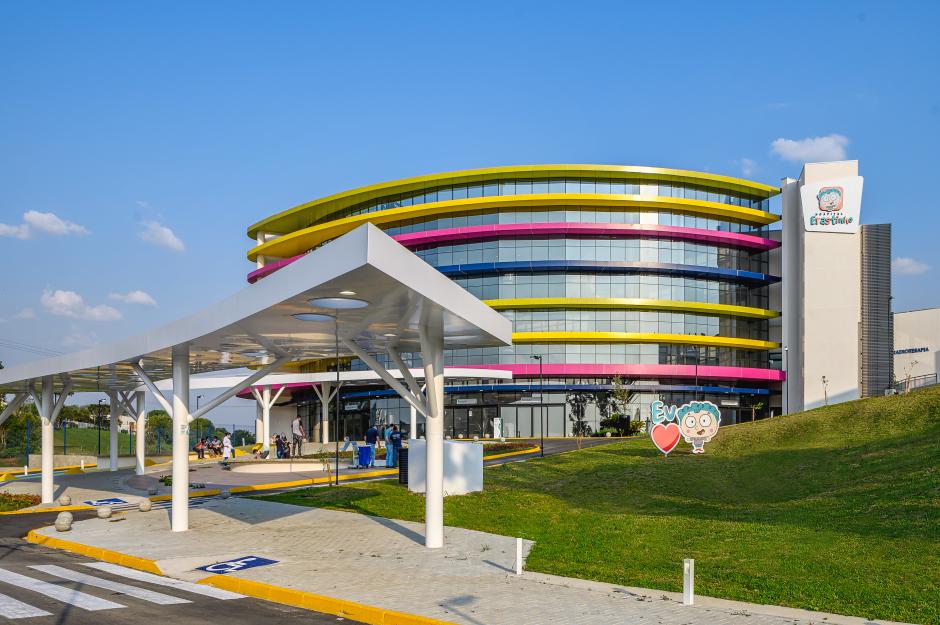
Some establishments go even further, by incorporating all these comfort factors right from the design stage. This was the case for the Erastinho pediatric oncology hospital in Brazil. The first healthcare facility in Latin America to achieve LEED Gold certification, this hospital designed its 4,800 m² as a healing environment. Architecture with colorful façades, bathed in natural light thanks to Vetrotech glazing; optimal acoustic comfort with Ecophon systems and Rigitone ceilings; high-performance insulation provided by Isover solutions; Placo® partitions equipped with Glasroc®X panels resistant to high temperature, and so on. Each component contributes to creating a soothing environment for vulnerable young patients.
Reconciling energy savings and comfort
These examples bear witness to the growing ambition to provide a high-quality hospital environment. But creating such an environment is a major challenge. While some establishments have taken the plunge, not all have yet made the transition. At an average of 239 kWh/m² per year in France, hospitals are among the highest energy consumers. In the United States, this figure rises to 738.5 kWh/m²/year, 2.6 times higher than for commercial buildings. It is thus essential to design energy-efficient facilities capable of lasting over time, especially as these buildings have to operate continuously, 24/7, without ever compromising strict health standards.

Scheduled to open in 2027, the future University Hospital in Nantes, France, perfectly embodies this complex equation. This is one of the largest hospital construction sites in Europe. Eleven Saint-Gobain Group entities are working on the project to address three issues: energy efficiency, space flexibility and user comfort. “For this hospital project, we selected solutions from the Group’s brands that are particularly well-suited and adaptable to the medical environment,” explains Antoine Paturel, Head of Sustainable Habitat West and South-West France, Saint-Gobain Solutions France. “Plasterboard with Activ’Air® technology to improve indoor air quality, solutions that are easy to clean to comply with hygiene protocols, and very hard boards for corridors where beds and stretchers are constantly passing through.”
Other solutions adopted include ECLAZ® SUN solar control glazing, which limits heat gain while maximizing natural light. There is also the EnveoVentF Duo lightweight façade solution, which offers significant structural gains, thus reducing the building’s carbon footprint.
Beyond materials, digitization is also transforming the day-to-day management of buildings. Other healthcare facilities are exploring solutions such as BrainBox AI, which modulates ventilation in real time according to occupancy, optimizing energy consumption while helping to reduce the potential viral load. This innovation is particularly relevant in healthcare facilities where air quality is an absolute priority.
When innovation makes sustainable construction affordable
Modular construction, an emergency solution
Comfort and energy savings are the two pillars of modern hospital design. Beyond these basic issues, the 2020 Covid crisis revealed a third, equally crucial imperative: adaptability. In just a few days, it was necessary to transform normal wards into intensive care units, create isolation zones and reconfigure entire areas. Developments in surgery and the constant arrival of new medical technologies also require buildings capable of reinventing and reorganizing themselves. The answer is a new generation of modular construction solutions, such as movable or removable partitions.
With solutions that can rapidly transform a waiting room into a consultation area, or a corridor into a vaccination cubicle, the hospital is no longer a structure that constrains medical practices, but a tool that adapts to their evolving needs, reconciling sustainability and innovation. These requirements have made it possible to build up expertise that can now be transposed to other sectors. The hospital that heals through its materials is thus paving the way for a wider transformation: of all our living spaces, designed for well-being, energy savings and adaptability.