
Indonesia’s first “Net Zero House”
To help meet the housing challenge in Indonesia, Saint-Gobain is innovating with a prototype “Net Zero House”. It combines modular construction, energy efficiency and sustainable solutions.
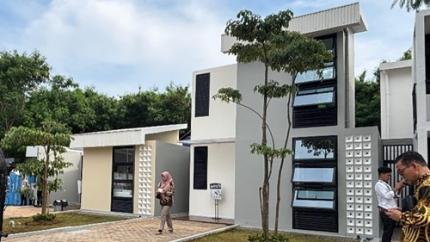
Indonesia faces a colossal challenge: filling a housing shortfall of 3 million homes while meeting its climate commitments. To help meet both requirements, Saint-Gobain Indonesia has unveiled an unprecedented prototype solution: the country’s first “Net Zero House”. Developed in partnership with PT Wijaya Karya Bangunan Gedung Tbk (WEGE) and PT Dex Solusi Transit (Dex), it opens up a promising path towards housing that is both accessible and environmentally friendly.
The house is innovative in three main areas. First, its modular design means it can be built in just one month, 60% faster than conventional methods. Because it is modular, this “scalable house” can be expanded to meet the changing needs of its occupants.
Then, its energy-efficient approach combines solar panels and optimized design to drastically reduce the need for air conditioning. Natural ventilation created by louvered windows and a planted central patio improves air circulation, while Saint-Gobain high-performance solar control glass significantly reduces the heat load.
It also incorporates over 35% Saint-Gobain futuRE solutions, a range launched in November 2024 bringing together the most sustainable solutions from six Group brands: Isover, Gyproc, Weber, Ecophon, Mortar Utama and ADFORS.
A dedicated mobile application lets occupants track energy consumption and solar output in real time. With four layouts available, ranging from 33 m² to 129 m², this “Net Zero House” is accessible to people of all income levels, while maintaining the same high standards of energy efficiency.
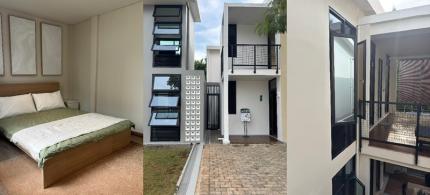
This pilot project paves the way for a wider transformation of Indonesia’s construction sector. Net Zero GREENSHIP certification from the Green Building Council Indonesia, currently in progress, will open up the possibility of “green” funding and reinforces the environmental credibility of the concept. The next practical step will be the launch of the first commercial project in Bali, marking the transition from experimentation to operational deployment.